Core values exercise: find your top five

A core values exercise is useful when words like "success," "freedom," or "connection" sound important but do not help you decide what to do next. The exercise asks you to choose a few values, define what each means in your own life, and compare those definitions with your recent choices.
Set aside about 20 minutes. You will use the list below to narrow roughly 60 words to ten, then to five. For each final value, write one behaviour that would show it in an ordinary week. At the end, look at last month's calendar and spending to see whether your time and money reflect what you say matters.
Values are personal. Two people can choose "family" and mean different things by it. Your definition matters more than the word. If you want a broader view of how meaning fits with other parts of life, explore the Purpose & Meaning hub, the Growth & Skill hub, and the Self-Direction hub. For related reading, see why finding your passion can be bad advice and what direction can feel like.
What values can help you decide
A value is a principle you want to bring into the way you act. It is different from a goal, which has a finish line. "Write a book" is a goal. "Creativity" might be a value that shapes how you work, even after one book is done.
Values can help you choose between two reasonable options. If you value learning and stability, you might choose a course that fits your schedule instead of quitting your job to study full time. If you value connection and quiet, you might plan one meaningful visit and leave the rest of the weekend open.
A values list is not a demand to live perfectly. It gives you language for the trade-offs you want to make. You can value adventure and still choose a familiar routine this month. Circumstances can limit what is possible. The exercise helps you identify what you want to make room for when you can.
Step 1: choose ten words from the list
Read the list once without trying to rank every word. Put a mark beside the ones that pull your attention. Choose words because they describe how you want to act, not because they sound admirable.
Values list
Acceptance, achievement, adventure, art, authenticity, balance, beauty, belonging, boldness, care, challenge, clarity, collaboration, community, compassion, competence, connection, contribution, courage, creativity, curiosity, dependability, discovery, diversity, fairness, faith, family, flexibility, freedom, friendship, fun, generosity, growth, honesty, humour, independence, influence, integrity, justice, kindness, knowledge, leadership, learning, loyalty, mastery, nature, openness, order, patience, peace, play, privacy, recognition, reliability, respect, responsibility, security, service, simplicity, skill, stability, stewardship, teamwork, tradition, trust, usefulness, wonder.
Now narrow the marked words to ten. Compare words that overlap. If you chose both "learning" and "growth," ask whether they mean separate things to you. If not, keep the one that feels more concrete. If you chose "freedom" and "independence," write a quick definition for each before deciding whether both belong.
Do not worry about finding the perfect word. You can rename it later. The point is to get a manageable set that feels like yours.
Step 2: choose your top five
Write the ten words on separate scraps of paper or in a list you can rearrange. Imagine that you could protect only five of them in the way you spend your attention this month. Which would you keep?
For each pair that feels hard to choose, ask:
- Which one would I miss more if it disappeared from my week?
- Which one has guided a decision I made recently?
- Which one do I want to practise even when nobody notices?
Choose five and put them in order if that helps. The ranking is only a way to make trade-offs visible. It does not mean that the fifth value is unimportant or that the first one always wins.
Check whether the words came from your own choices or from expectations you have absorbed. A word can still be yours even if someone introduced it to you. The useful test is whether you want it to guide your actions now.
Step 3: define what each word means to you
Write one or two sentences for each value. Use examples of behaviour, not another abstract word. "Integrity means being aligned" does not help you recognise what to do. "Integrity means telling a colleague early when I cannot meet a deadline" gives you a real action.
Try this prompt for each value: "When I live this value on an ordinary Tuesday, what would someone see me do?"
For example:
| Value | My definition | One visible behaviour |
|---|---|---|
| Curiosity | I make room to ask before I decide | Ask one follow-up question in a meeting |
| Friendship | I keep in touch without waiting for a special occasion | Send one message on Sunday |
| Stability | I give important tasks a predictable place in the week | Reserve Tuesday morning for planning |
Be honest about the word's limits. If you value generosity, you may also need a boundary so you do not offer time you cannot spare. If you value achievement, decide what you will not give up to reach a goal. A value is more useful when you can describe both how it guides you and when it should not take over.
Step 4: compare values with last month's calendar
Open your calendar for the last four weeks. Look at the time you actually spent, not only the plans you intended to keep. For each value, mark an event or block of time that expressed it. If you cannot find one, write "no clear example." That is information, not a failure.
Consider these questions:
- Which value appeared in my week without much effort?
- Which value had no place on the calendar?
- What recurring commitment took time from something I say matters?
- Was the gap caused by a choice, a constraint, or both?
Suppose you choose friendship but see no time with friends in the calendar. The next step may be small: set one call, invite someone for lunch, or tell a friend when you are free. If the month was unusually busy, you might choose a realistic date for the next month rather than judging the past one.
Step 5: compare values with your spending
Review the last month of spending at a high level. You do not need to label every purchase. Look for categories or individual choices that connect with your five values.
If you value learning, did you pay for a course or materials you used? If you value community, did you contribute time or money in a way that mattered to you? If you value security, did you set aside anything for a future commitment? The answers will vary with your circumstances and resources.
Do not treat spending as a perfect measure of what matters. Time, access, income, and other obligations affect what you can choose. Use the review to notice one pattern, then decide whether you want to continue it or adjust it.
Turn one value into a small action
Choose a value that matters and has room for more attention. Write an action with a date and a clear finish. If you value curiosity, it could be "Ask Noor how she learned the new tool during Thursday's check-in." If you value rest, it could be "Keep Saturday morning free of errands this week." If you value contribution, it could be "Spend 20 minutes helping with the neighbourhood event on Wednesday."
Make the action fit your actual week. A small behaviour you can do is more useful than a promise to redesign your whole life. Put it in your calendar or attach it to a routine you already have.
At the end of the week, ask whether the action felt like a real expression of the value. If not, adjust the behaviour or the definition. You are allowed to learn that a word does not mean what you first thought it did.
Revisit the list when your life changes
Your five words do not need to stay fixed forever. A new responsibility, a move, a different role, or a changing relationship can alter what you need to protect. Return to the list when your old definitions stop helping you make choices.
You can also review the list every few months. Keep what still fits, replace words that feel borrowed, and add one that you missed. The aim is not to hold a permanent identity statement. It is to have a useful set of principles for the decisions in front of you.
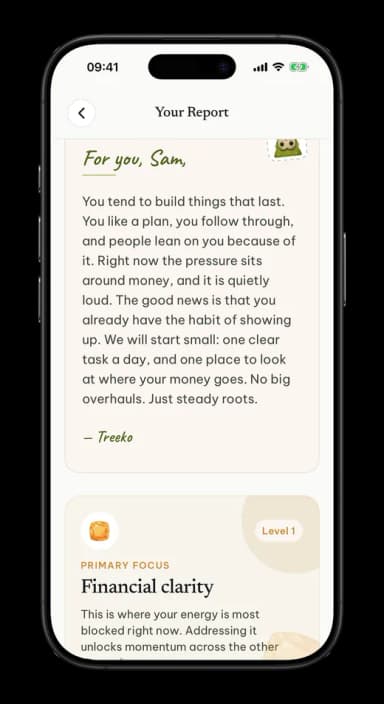
Rooted's Purpose & Meaning area looks at how your daily choices connect with what matters to you. The short assessment gives you a written report across six areas and one small daily task. Take the free test if you want to see where to begin.
Frequently asked questions
What if I cannot choose only five values?
Choose five for this exercise, then keep the others on a second list. The limit helps you see trade-offs. You can revisit the list after trying the exercise.
Should I choose values that are strengths I already have?
Some values may describe actions you already take. Others may name behaviour you want to practise. Both can belong on your list.
Are values the same as personality traits?
No. A trait describes a pattern or quality. A value is a principle you want to use when choosing how to act.
What if my calendar does not match my values?
Look for one change you can make under your current constraints. A mismatch may point to a choice, a limit, or a responsibility you need to account for.
See which of your six roots needs attention. Take the free self-assessment in the Rooted app.