Self-discovery journal prompts across six areas

The best self-discovery journal prompts give you something specific to notice. A question like "Who am I?" is large enough to leave you staring at the page. A question about a recent choice, conversation, or hour of your day gives you a place to begin.
Use this list across six areas of life: self-direction, connection, money, growth, purpose, and energy. Choose one prompt, set a timer for ten minutes, and write without trying to sound wise. When the timer ends, mark one sentence that feels worth keeping. You do not have to answer all 48 questions or write every day.
If you want a wider map before choosing a prompt, read the six roots explained. For a more structured check of how those areas are going, use What a real self-assessment tells you.
How to use a journal prompt
Choose the area that has been on your mind lately. Read its prompts once and pick the question that gives you a concrete memory or situation. Write the date, copy the question, and start with what happened. Avoid polishing the entry while you are writing it.
When you get stuck, use one of these follow-ups:
- What is one recent example?
- What did I expect to happen?
- What did I do next?
- What would I try if this happened again?
After ten minutes, read the entry once. Underline a detail you did not want to forget. Then decide whether to take one small action, ask someone a question, or leave the note alone for now. Reflection does not need to end in a project.
Self-direction prompts: choices and follow-through
Self-direction is about the choices you make and the plans you carry out. These prompts help you notice where your time goes and which small commitments you keep.
- What did I choose to do first today, and why?
- Which task did I postpone this week? What was the first unclear step?
- When did I say yes before checking whether I had time?
- What routine made one part of the day easier?
- Which promise to myself did I keep in the last seven days?
- What decision would be easier if I gave myself two options instead of ten?
- What do I want to protect an hour for next week?
- Which reminder, object, or change of place would help me begin?
If one answer points to a routine you want to change, explore the Self-Direction hub. Choose an action that fits in the day you actually have, not an ideal version of your schedule.
Connection prompts: friendships and communication
Connection can show up in a long conversation or in the small ways you keep in touch. These questions focus on moments you can remember, rather than a score of how many people you know.
- Who made me feel welcome in a recent conversation?
- Who would I like to hear from, and what could I say first?
- Which plan did I enjoy even though I almost cancelled?
- What is one thing I have wanted to tell someone clearly?
- When did I listen without planning my reply?
- Which relationship would benefit from a regular time together?
- What kind of invitation is easy for me to accept?
- What boundary would make a relationship more workable?
You could send one message after journaling, or put a date on the calendar. The Connection & Communication hub has more prompts for making room for the relationships you value.
Financial clarity prompts: money and priorities
These questions are for understanding your choices and plans. They do not ask you to compare income or adopt a financial product.
- What money task did I handle this week?
- Which regular cost do I want to understand better?
- What purchase felt worth the money I spent?
- What money conversation would help me plan with someone else?
- What do I want to save for, even if the first amount is small?
- When do I avoid looking at a number? What would make the first look easier?
- Which recent choice reflected something I value?
- What one number would be useful to check once a week?
Pick a practical next step, such as listing the next three due dates or checking one recurring charge. The Financial Clarity hub focuses on understanding your current picture.
Growth prompts: learning and practice
Growth does not need to mean a promotion or a dramatic achievement. It can be the slow work of practising a skill, asking for feedback, or finishing something you began.
- What have I practised enough to notice a change?
- Which useful skill would make work or home life easier?
- What did I learn from something that did not go to plan?
- Which task am I avoiding because I might be a beginner?
- What feedback have I received that I want to test?
- What would count as progress by the end of this month?
- Who could show me one part of the skill I want to learn?
- Which small piece of work could I finish this week?
For the next step, choose a practice session and put it on your calendar. The task should fit the time you actually have.
Purpose prompts: values and meaning
Purpose can be built from ordinary decisions. These prompts ask what you value and where it appears in your recent actions. If you want to name your priorities more directly, try a core values exercise.
- What did I do recently that felt worth the effort?
- Which value showed up in a decision I made this week?
- What kind of help do I like giving to other people?
- What do I want a friend to know they can count on me for?
- Which part of my work would I keep if no one praised it?
- What do I make room for even when the week gets busy?
- What choice would feel more like mine?
- Which responsibility do I want to handle with more care?
Look for examples in your calendar and recent choices. A value becomes easier to understand when you can point to a time you acted on it.
Energy prompts: pace and the shape of your day
Use these prompts to notice how your schedule affects your capacity. They are about planning and everyday experience, not medical advice.
- At what time of day did focused work feel easiest this week?
- Which commitment took more time than I expected?
- What did I do between tasks that helped me reset?
- Which part of my day felt rushed, and what made it that way?
- What could I move to a time when I have more attention?
- Which regular activity gives me a useful change of pace?
- What is one task I could break into two shorter sessions?
- What would a more workable afternoon look like tomorrow?
Try tracking only one thing for a week, such as when you do focused work or how long a meeting runs. The task is to notice a pattern you can use, not to record every part of the day.
Find the pattern in your answers
After a few sessions, reread the sentences you underlined. Look for repeated situations, not a fixed label about yourself. Perhaps several entries mention agreeing before checking your calendar. Maybe the same hour keeps appearing as your best time to write. Those details can point to a change worth testing.
Use this three-line summary:
- I notice: name the repeated situation.
- It matters because: say what it changes for you.
- Next I will: write one small experiment.
For example: "I notice I answer messages between every task. It matters because I lose the time I set aside for writing. Next I will check messages after I finish the first paragraph." Keep the experiment small enough to try this week. You are gathering information, not committing to a permanent rule.
If your entries point in different directions, leave them that way. People can want both quiet and company, security and change, or independence and help. A journal does not need to make every preference agree. It can help you see when each one matters.
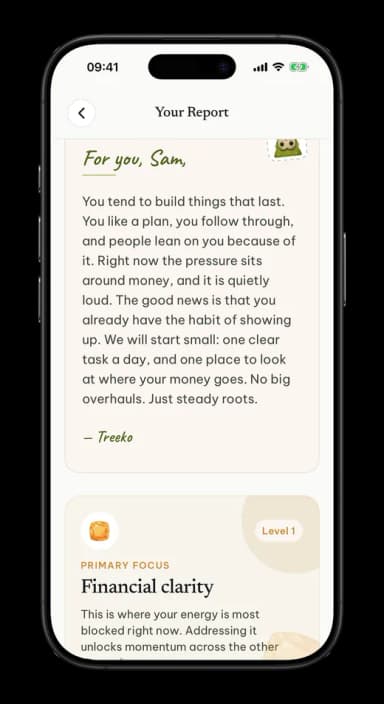
Rooted's assessment looks across six areas and gives you a written report with one small daily task for a place to begin. The Purpose & Meaning hub offers another way to reflect on what matters. Take the free test if you want that guided view.
Frequently asked questions
What if a prompt brings up nothing?
Choose a more concrete question or think of the last week instead of your whole life. You can also write, "I do not know yet," then note what you might observe next.
Is it better to write by hand or type?
Use whichever method makes it easier for you to begin and reread your notes. The prompt matters more than the format.
Should I keep my journal private?
That is your choice. You can keep the entry to yourself or share a specific question with someone you trust. Do not share it just because you think you are supposed to.
What if I miss a week?
Pick one prompt the next time you want to reflect. You do not need to catch up or fill in the days you missed.
See which of your six roots needs attention. Take the free self-assessment in the Rooted app.